
Last updated November 2, 2026
 Whole-home duct cleaning
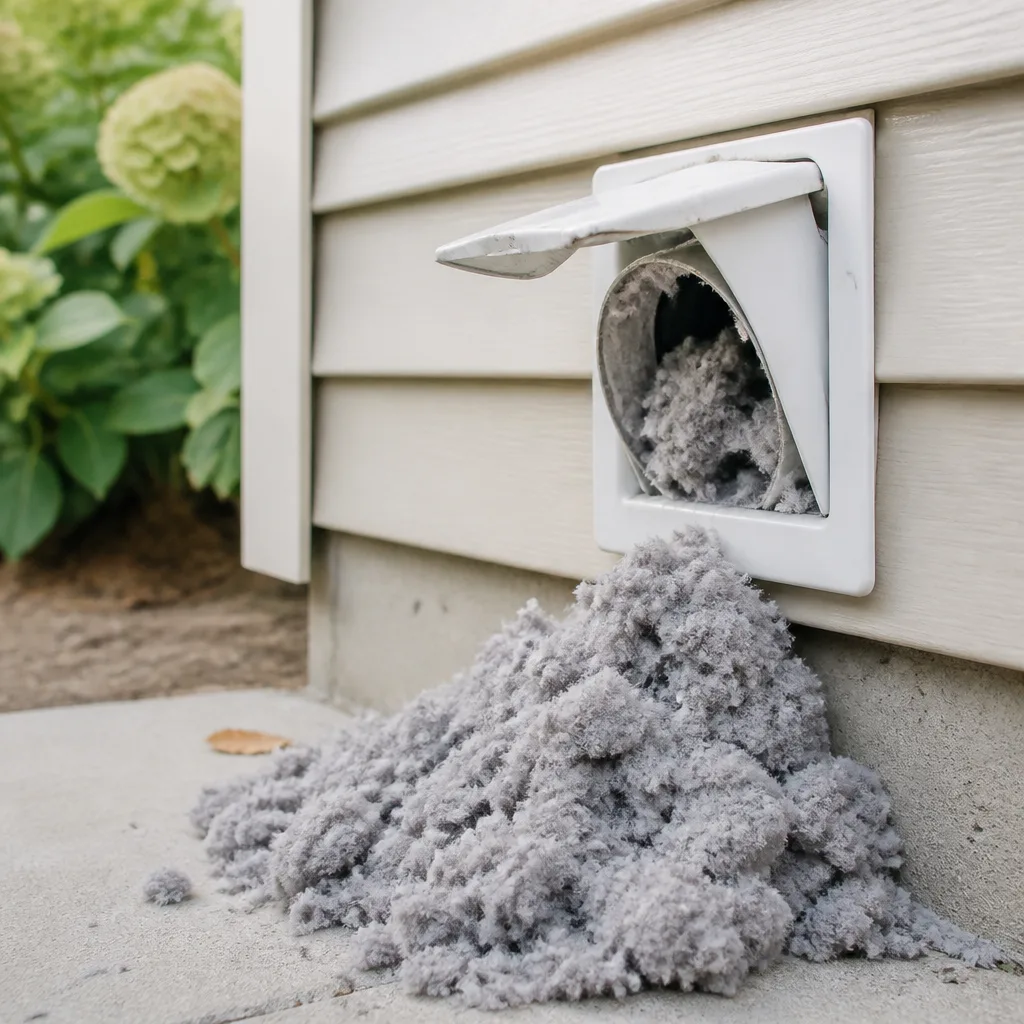 Dryer vent cleaning
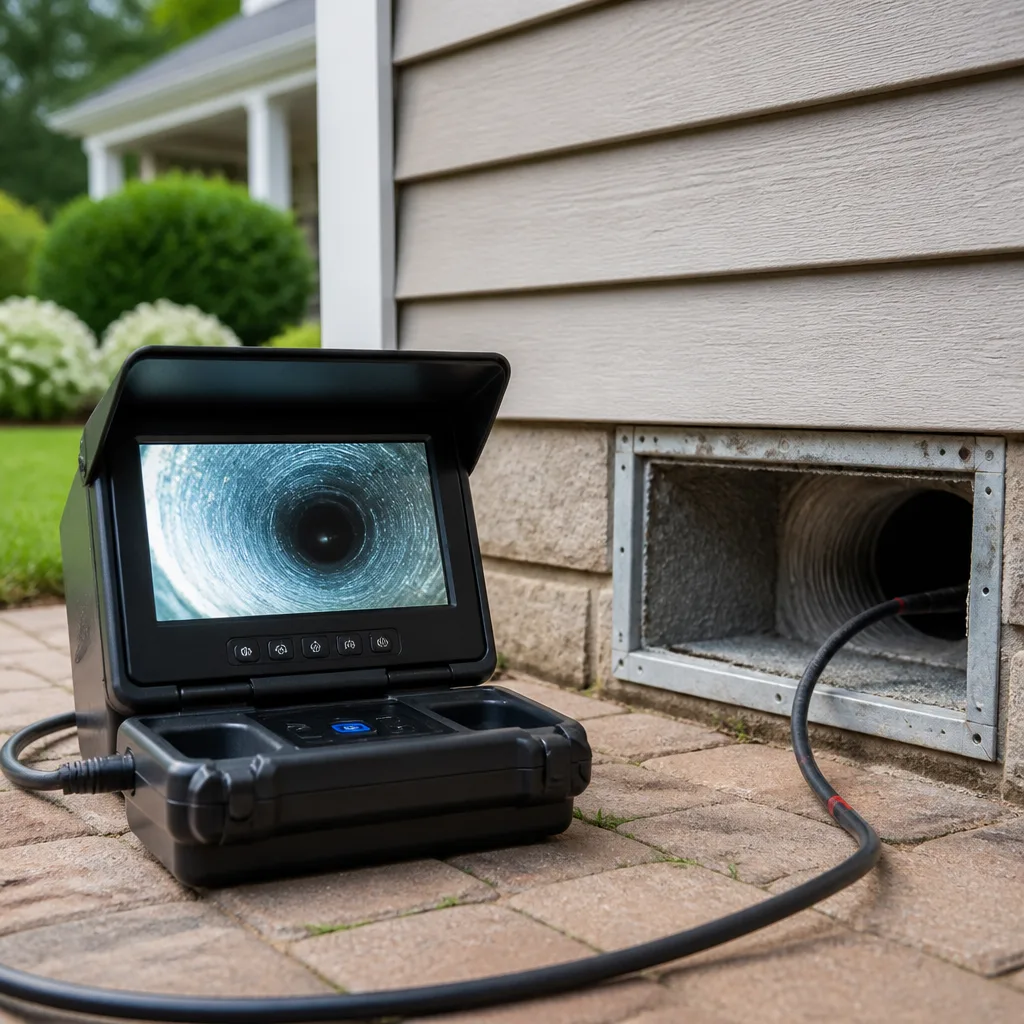 Camera inspection
 Sanitizing & deodorizing
Whole-system duct and dryer vent check with before-and-after photos - you see exactly what came out of your vents
That "$99 whole-house special" is a bait ad - the real number appears once they are in your hallway, or the "clean" is a shop-vac at the register. We photograph the inside of your ducts before and after instead.
Air Duct Cleaning Maintenance Checklist for Hemet Homeowners
A standard 1-inch filter rated MERV 8 can load to capacity in under 30 days during a Hemet dust event, yet most maintenance checklists still tell you to change it every 90 days regardless of location. That generic advice fails Hemet homeowners because our air carries a specific mix: fine desert silt from the San Jacinto Valley floor, ash particulate from wildfire smoke that settles into the valley, and agricultural dust from surrounding groves. This guide gives you a maintenance routine calibrated to those local conditions. You’ll learn what to inspect monthly, what seasonal events demand immediate attention, and when a filter swap or visual register check crosses the line into professional air duct cleaning or repair territory.
Quick Answer
An air duct maintenance checklist for Hemet homeowners should include monthly filter checks during dust season, visual inspection of supply registers for dust accumulation, seasonal inspection of flex duct connections at the plenum, evaporative cooler crossover cleaning before summer, and a documented photo log of register condition. Most Hemet homes need filter replacement every 30-45 days during Santa Ana season rather than the standard 90, and any visible dust accumulation inside the duct itself, sagging flex runs, or disconnected boots warrant professional air duct cleaning or repair.
Styles & brands we work with
- Whole-home duct cleaning
- Dryer vent cleaning
- Camera inspection
- Sanitizing & deodorizing
Table of Contents
- The Hemet Seasonal Maintenance Calendar
- Monthly Register and Grille Inspection Routine
- Filter Selection for Hemet’s Dust Load and Older Duct Systems
- Inspecting Flex Duct Connections Without Professional Tools
- Evaporative Cooler Crossover and Duct Contamination
- Wildfire Smoke and Post-Fire Particulate Protocol
- Building a Maintenance Photo Log
- When DIY Maintenance Is Not Enough
The Hemet Seasonal Maintenance Calendar
Hemet’s climate does not follow the generic four-season template that most HVAC maintenance guides assume. We have three distinct dust and contaminant seasons, each demanding a different response. Understanding this calendar is the difference between a maintenance routine that actually protects your ducts and one that just creates busywork. For Air Duct Cleaning Permits, Codes & Inspections in CA: What You Need to Know, see our compliance guide.
Here is a month-by-month timeline tied to what actually happens in the San Jacinto Valley:
- September through November (Santa Ana wind season): This is Hemet’s heaviest dust-loading period. Northeast winds channel through the Banning Pass and push fine desert silt across the valley floor. Filters clog fastest during these months, and that dust finds its way into return plenums through any gap. Check filters every 2 weeks, not monthly. Inspect return grilles weekly for visible dust caking.
- December through February (winter heating season): Dust loading moderates but does not stop. Your furnace runs more frequently, pulling air through whatever the filter has already captured. This is the right time to inspect the blower compartment and check for dust accumulation on the blower wheel, which reduces airflow and strains the motor. Also check that supply registers are fully open in rooms you actually use.
- March through May (spring transition): As temperatures climb, your system switches from heat to cool. Before that switch happens, this is the best window for a full visual inspection of accessible ductwork in the attic. The mild temperatures make attic work tolerable, and you can identify any damage from winter rodent activity or summer heat stress before the cooling load hits.
- June through August (monsoon dust and peak cooling): Summer thunderstorms build in the mountains and send gust fronts across the valley, kicking up dust. Your AC runs near-continuously, meaning the system is pulling air through ductwork at maximum duty cycle. Any existing leak or disconnection compounds quickly. This is when you’ll notice rooms that can’t hold temperature, which often points to a duct issue rather than an undersized unit.
- Post-summer restart (late August to early September): Before the Santa Ana cycle begins again, inspect everything that accumulated dust during cooling season. This is the ideal moment for professional air duct cleaning if your registers show visible dust buildup, because the system has completed its heaviest annual run and you’ll capture everything before the next dust season layers on top of it.
The reality of Hemet’s dust cycle is that your system never gets a true off-season. The question is not whether to do maintenance, but which maintenance matches the month you’re in. If you’ve lived in Hemet through even one full year, you’ve already felt the difference between a filter that’s still working and one that’s turned into a felt-like barrier. That experience is your best calibration tool.
Monthly Register and Grille Inspection Routine
Supply registers and return grilles are the only visible endpoints of your duct system, and they tell you what’s happening deeper inside. A monthly five-minute inspection gives you more diagnostic information than any guesswork. The key is knowing what you’re looking at and what the patterns mean.
- Remove the register cover: Most Hemet homes have stamped steel registers held by two screws. Take the cover off and set it aside. Look at the inside surface of the register boot, the metal box the register screws into. A light coating of fine dust here is normal. A thick, greasy-looking accumulation that has bonded to the metal means particulate has been passing through your filter and settling through the system.
- Check the immediate duct interior: With a flashlight, look down into the boot where it meets the duct run. You should see relatively clean metal with perhaps a light film. If you can wipe a finger across it and come away with visible dust, that duct segment is carrying particulate that the filter is not stopping.
- Examine the return grille: Return grilles collect dust because air is being pulled through them. A light dust layer is expected. But if the grille is visibly clogged enough that you can see through it poorly, your filter has been letting too much through for some time, or the filter has been missing or poorly seated.
- Check for streak patterns: Dark streaks on walls near supply registers indicate particulate-laden air is leaking around the register frame rather than passing through the register face. This is a sealing issue, not a cleaning issue, and it points to air bypassing the register boot entirely.
- Record what you find: Photograph any register that looks concerning. A photo from today is your baseline for comparison in 30 or 60 days. If the dust accumulation returns quickly, that’s a signal the duct cleaning you did (or skipped) hasn’t addressed the source.
This inspection routine takes five minutes once a month and costs nothing. What it gives you is pattern recognition. You’ll learn which registers in your Hemet home load dust fastest, which tells you where return air is pulling from unconditioned spaces, and whether your filter is actually doing its job. In our experience, homeowners who do this monthly inspection catch duct disconnections and filter problems months before a full system failure would have made them obvious.
Filter Selection for Hemet’s Dust Load and Older Duct Systems
The filter aisle at any hardware store presents a choice that seems like a no-brainer: higher MERV means better filtration, so buy the highest MERV filter available. That logic works in a laboratory and breaks down in many Hemet homes, especially older tract homes built during the valley’s boom decades. The reason is airflow math, and ignoring it costs you more than dust.
A filter is a restriction in the airstream. A MERV 8 filter restricts airflow a little. A MERV 13 filter restricts it a lot. A residential air handler is designed around a specific static pressure target, typically 0.5 inches of water column. Older Hemet homes often have undersized return plenums, which already elevate static pressure before the filter enters the equation. Add a high-MERV filter to that system and you get reduced airflow across the evaporator coil, which can lead to coil freezing in summer, reduced heating capacity in winter, and a blower motor working harder than it was designed to.
The practical guidance for Hemet homeowners looks like this:
- If you have an older home with a single return in a hallway: Stay at MERV 8 to MERV 10. The cost of higher filtration is airflow starvation. Replace filters every 30 days during Santa Ana season and every 60 days otherwise.
- If you have a newer home or a system with multiple returns: MERV 11 to MERV 13 is workable, but verify airflow at the registers hasn’t noticeably dropped after installation. If rooms get warmer or the system runs longer after you upgrade filters, go back down a tier.
- If someone in the home has severe allergies or respiratory conditions: The better answer is not always a higher-MERV 1-inch filter. It’s often a media cabinet with a 4-inch filter that provides higher MERV with less airflow restriction due to greater surface area. That’s a system modification, not a filter swap.
- Never run the system without a filter: A missing filter can permanently contaminate the evaporator coil and duct interior. Cleaning a coil after a filter-less month is an expensive lesson.
We work with air duct cleaning in Hemet systems that use Aprilaire media cabinets and other filtration platforms, and the principle is consistent: match filter restriction to your duct system’s capacity. If your ductwork already struggles with airflow, the filter is not where you add resistance. The ducts themselves may need repair to enlarge the return path, which is a different discussion than filter selection.
Inspecting Flex Duct Connections Without Professional Tools
Flex duct, the flexible insulated tubing that connects rigid trunk lines to register boots, is standard in Hemet residential construction. It’s effective and inexpensive, but it has predictable failure modes: sagging, disconnection at the plenum, crushing under attic debris, and rodent damage. You can inspect accessible flex duct runs yourself with a flashlight, a step ladder, and about twenty minutes in your attic.
Here’s what to look for and how to know it’s a problem:
- Sagging between supports: Flex duct should be supported every 4 feet with straps that are at least 1.5 inches wide. If you see a duct run drooping more than a few inches between support points, airflow is being restricted by the sag. Sagging never improves on its own, and the weight of accumulated dust inside the droop makes it worse over time.
- Disconnection at the plenum or boot: Flex duct attaches at each end with a zip tie or band clamp over the inner liner, then the insulation is pulled over and secured. If you see insulation pulled away from the connection, or the inner liner visible, the connection has failed. Even a partial disconnection allows conditioned air to dump into the attic and pulls attic dust into the system.
- Crushing or kinking: Anything resting on a flex duct, whether it’s a box of holiday decorations or another duct crossing over it, creates a choke point. A flex duct crushed to half its diameter delivers roughly a quarter of its rated airflow. In Hemet attics, heat can soften flex duct and make it more susceptible to kinking at sharp bends, so look at any bend sharper than 90 degrees.
- Evidence of rodent activity: Rats and mice are a reality in Hemet attics. Look for chew holes in the outer vapor barrier, shredded insulation around connections, and droppings near duct runs. Rodents inside a flex duct are a contamination problem as much as an airflow problem, and that requires professional cleaning or duct replacement rather than tape.
Flex duct inspection is one of the highest-value maintenance activities a Hemet homeowner can do, because flex duct failures are common, progressive, and invisible from inside the living space until the energy bill or comfort level makes it obvious. If you find disconnections or sagging that you’d rather not fix yourself, air duct repair in Hemet is the service that addresses damaged ductwork, and it’s a different skillset than cleaning. We repair what others only clean around.
Evaporative Cooler Crossover and Duct Contamination
A meaningful number of Hemet homes use evaporative coolers, also called swamp coolers, either as the primary cooling system or as a supplement to central air. Evaporative coolers pull outdoor air across water-saturated pads and push it through the same ductwork that the furnace uses in winter. That crossover creates a unique contamination pattern that generic maintenance guides never address.
During cooling season, evaporative coolers push air through ducts at relatively high humidity. Dust that enters the cooler from the outdoor air sticks to the moisture inside the duct lining. When the season ends and the furnace takes over, warm dry air bakes that moisture-laden dust into a crust. The result is a layer of bonded particulate inside the duct that resists normal airflow and becomes a food source for anything microbial in a humid week. This is not theoretical; it’s a predictable annual cycle in Hemet homes with cooler crossover.
Evaporative cooler owners should add these steps to the seasonal calendar:
- Before cooler season: Inspect the cooler’s distribution ductwork for debris that accumulated during winter. Vacuum the cooler interior and verify the dump valve and water line are working. A cooler pushing water-saturated air through dust-contaminated ducts pushes that contamination deeper into the system.
- During cooler season: Check the pads every 2 weeks in Hemet’s hard water. Mineral caking on pads reduces cooling efficiency and increases the particulate load entering the ductwork. Replace pads when they become rigid or visibly crusted.
- After cooler season: Run the furnace fan only for 30 minutes on a dry day to purge residual humidity from the duct interior. Then inspect supply registers for any new dust accumulation. If register dust appears that wasn’t there before cooler season, the ducts absorbed contamination and pro cleaning is worth scheduling before winter.
- During the smoke event: Run the system on fan-only mode with a fresh filter, which provides some filtration without pulling additional outdoor air through the condenser. If your system has a fresh air intake, close it. This is not a long-term air quality solution, but it slows the rate at which smoke contaminates the duct interior.
- After the skies clear: Inspect the filter. If it’s gray or brown after a 30-day-old MERV 8, replace it immediately. More importantly, remove a supply register and inspect the boot interior. Smoke deposition shows up as a fine, uniform gray film rather than the chunky dust you’re used to seeing.
- Check for persistent smoke odor: Run the fan for 15 minutes. If you smell smoke in the supply air while the outdoor air is clean, the odor has absorbed into the duct lining or the filter media in the air handler. Ozone generators and air fresheners mask this; they don’t remove it. The particulate is bound to the duct surface and requires professional contact cleaning to fully remove.
- Document the event: Note the date of the smoke event in your maintenance log. If a professional cleaning is scheduled later, knowing exactly which fires the home was exposed to gives the technician useful context about the contaminant type.
- Create a dedicated album on your phone named “HVAC” or “Ducts.” Every photo related to your duct system goes there, no exceptions. This removes the friction of deciding where to file things later.
- Photograph every filter when you remove it. Place the used filter against a plain background, date side up, and take one photo. Over time, these photos show you exactly how quickly filters load in your home during different seasons.
- Photograph one supply register and one return grille every quarter. Use the same register each time. A series of photos from the same location over two years is more diagnostically useful than scattered photos from different registers.
- Note the date and any unusual conditions. A two-line note in your phone’s note app is sufficient: “March 14, replaced filter after 32 days, heavier than normal dust, Santa Ana event that week.” The pattern that emerges from these notes is your actual maintenance schedule, not a generic calendar.
- Share the log with any contractor you hire. When you schedule professional air duct cleaning, having a year of filter photos and register condition documentation means the technician starts from data rather than guesses.
- Visible dust accumulation extends beyond the register boot into the duct run itself. A brush and home vacuum can clean the first six inches. They cannot touch anything deeper, and the agitation they produce often pushes particulate further down the duct rather than removing it.
- You find sagging, disconnected, or rodent-damaged flex duct. Reconnecting flex duct properly requires knowing how to seal the inner liner, secure the insulation, and verify airflow at the register. A bad repair leaks the same conditioned air into the attic that the original failure did.
- Smoke odor persists after the outdoor air has cleared. Odor that survives filter replacement is bound to the duct interior, and removing it requires mechanical cleaning with HEPA-rated extraction equipment, not household deodorizers.
- Allergy symptoms worsen when the system runs. If you notice a correlation between system operation and respiratory irritation in your household, the duct system may be recirculating contaminants that a filter alone cannot address. This is a health signal that justifies professional evaluation.
Evaporative cooler crossover is one of the strongest indicators that a home needs professional-grade cleaning rather than a DIY effort. The bonded particulate inside the duct requires mechanical agitation to remove, which is what equipment like the Rotobrush rotary brush system is designed to do. A home vacuum cleaner attached to a register cannot touch that kind of deposit.
Wildfire Smoke and Post-Fire Particulate Protocol
Hemet sits in a valley that collects smoke from fires in the San Bernardino National Forest, the San Jacinto Mountains, and the high desert. When wildfire smoke settles into the San Jacinto Valley, it does not stay outside. Your HVAC system pulls that smoke-laden air in, and the particulate finds its way into every part of the system that air touches.
Smoke particulate is finer than normal dust, more chemically complex, and more likely to linger. It also has a distinct odor that can persist in ductwork long after the outdoor air has cleared. Hemet homeowners need a specific protocol for smoke events, because the standard “change your filter” advice does not fully address what smoke does to a duct system.
Here is a step-by-step post-smoke inspection and response routine:
For homes near open space or on the valley edges, wildfire smoke exposure is recurring rather than occasional. In those homes, a professional-grade filtration strategy matters more. We’re familiar with Honeywell and Aprilaire air quality components that integrate with existing HVAC systems, and we can advise whether a media cabinet upgrade makes sense for your specific duct configuration.
Building a Maintenance Photo Log
The most useful thing you can do for your long-term duct system health is also the simplest: take photos. A consistent visual record of register condition, filter changes, and inspection findings gives you something that most maintenance advice never mentions: a baseline.
Here’s how to build a documentation habit that actually works:
This documentation habit costs five minutes a month and gives you something that money can’t buy retroactively: a recorded history of exactly what your specific duct system was doing before a problem appeared. When a contractor tells you your ducts need cleaning or repair, you’ll have the photos to verify that claim against your own records. That’s leverage in any service interaction, and it’s the difference between trusting an estimate and verifying it.
When DIY Maintenance Is Not Enough
There’s a clear line between what a Hemet homeowner can reasonably maintain and what requires professional equipment. Knowing where that line sits saves you from both extremes: either ignoring a problem that’s getting worse, or attempting a cleaning job that you can’t actually accomplish with consumer tools. Our Air Duct Cleaning Troubleshooting: Common Problems and How to Fix Them walks through typical failure patterns.
DIY maintenance covers everything we’ve discussed so far: filter replacement, register inspection, flex duct observation, evaporative cooler pad checks, and documentation. These are visual inspections and simple component swaps. They require no specialized tools and no risk of damaging the system.
Professional service becomes necessary when:
When those conditions exist, the equipment matters. The difference between a professional cleaning that actually removes contaminants and one that just stirs them up comes down to the tools. We use rotary brush systems paired with HEPA-rated vacuum extraction, which is the same approach used in commercial and remediation settings. A shop-vac and a spinning brush attachment cannot generate the negative air pressure needed to capture particulate as it’s dislodged. The equipment makes the outcome, not just the effort.
Common Mistakes to Avoid
- Following a 90-day filter change schedule without checking actual loading. In Hemet, a MERV 8 filter can be fully loaded in 30 days during a Santa Ana wind event. Check filters monthly and replace when visually loaded, not on a calendar.
- Upgrading to a high-MERV filter without checking system airflow. Many Hemet tract homes have marginal return plenum sizing. A MERV 13 filter can reduce airflow enough to freeze a coil in summer. Match filter restriction to duct capacity, not to the allergy concerns of the moment.
- Ignoring evaporative cooler crossover contamination. Homes that run a swamp cooler in summer and a furnace in winter develop a unique bonded-dust problem in shared ductwork. The cooler season start and end require specific duct attention, not just pad replacement.
- Assuming a clogged filter means the system is protecting the ducts. A filter that’s fully loaded without a bypass creates a pressure differential that can draw unfiltered air through any gap in the return path. The filter being dirty does not mean the ducts are clean; it often means the opposite.
- Treating register dust as a cleaning issue rather than a diagnostic signal. Dust at one register but not others rarely means that one duct is dirty. It usually means that duct run has a leak or disconnection pulling attic air. Cleaning without repair treats the symptom and leaves the source.
- Using duct-sealing tape from a hardware store on a disconnected flex duct. Standard cloth duct tape degrades in attic heat within a season. Proper flex duct repair uses metalized tape rated for HVAC use, mastic sealant, and correct banding. A hardware store tape job looks fixed and performs like nothing was done at all.
- Not photographing anything. A maintenance routine you can’t reference is a guess. Photos of filters and registers create a record that tells you if your system is stable, improving, or deteriorating. Without them, every observation starts from zero.
See the difference
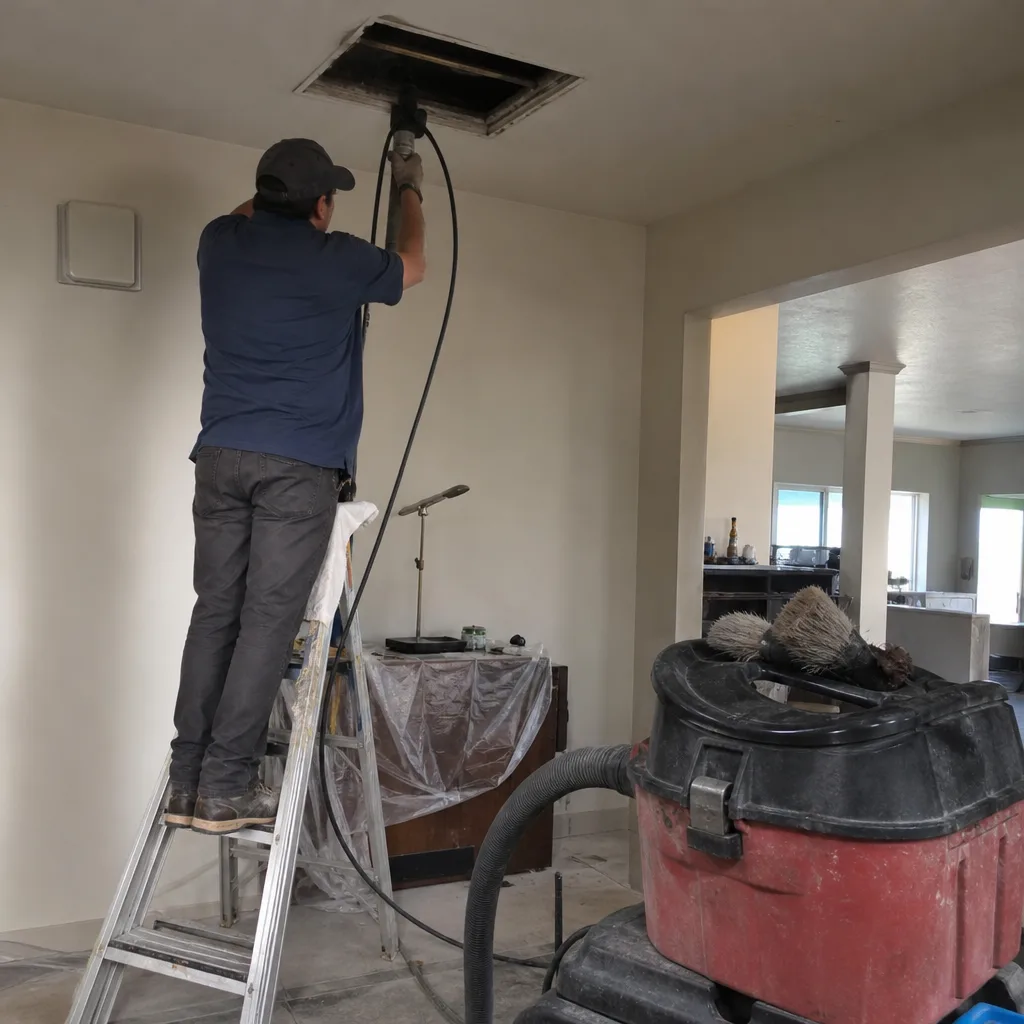 Before
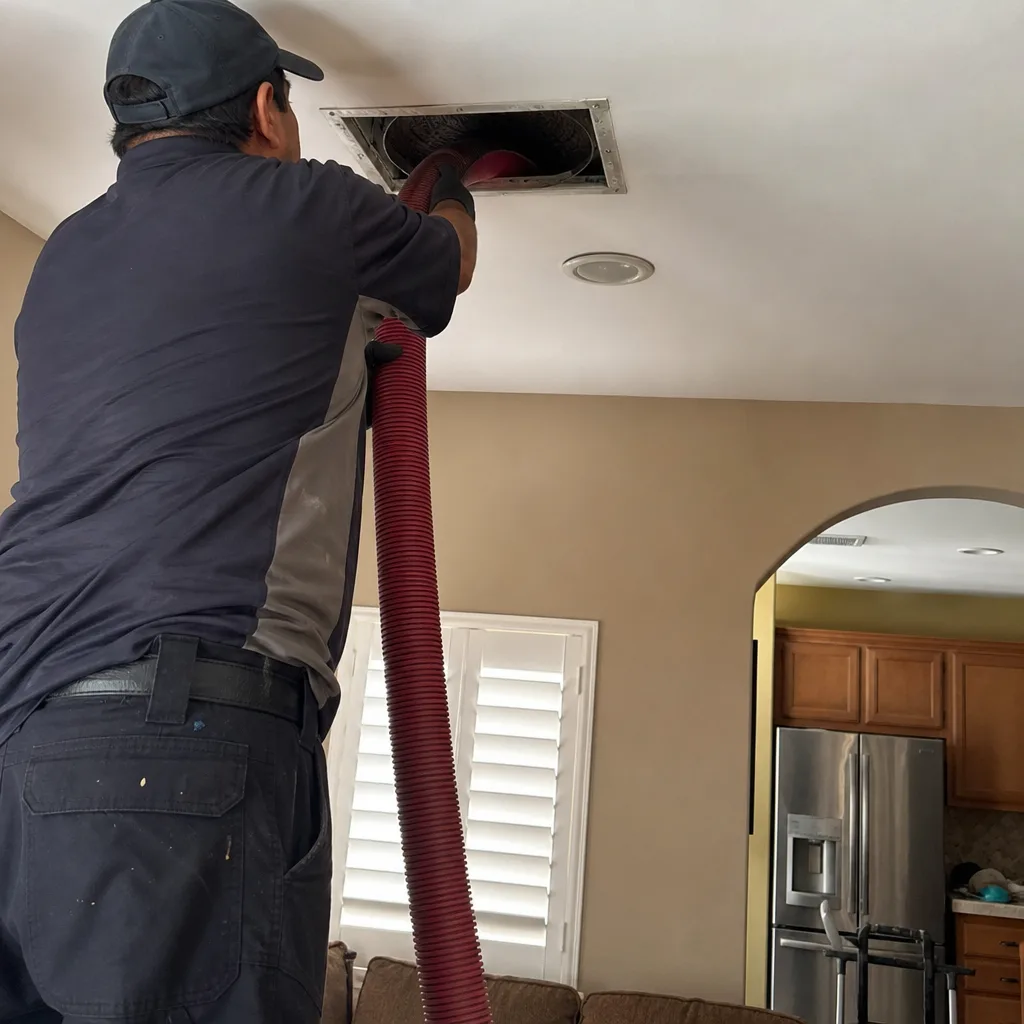 After
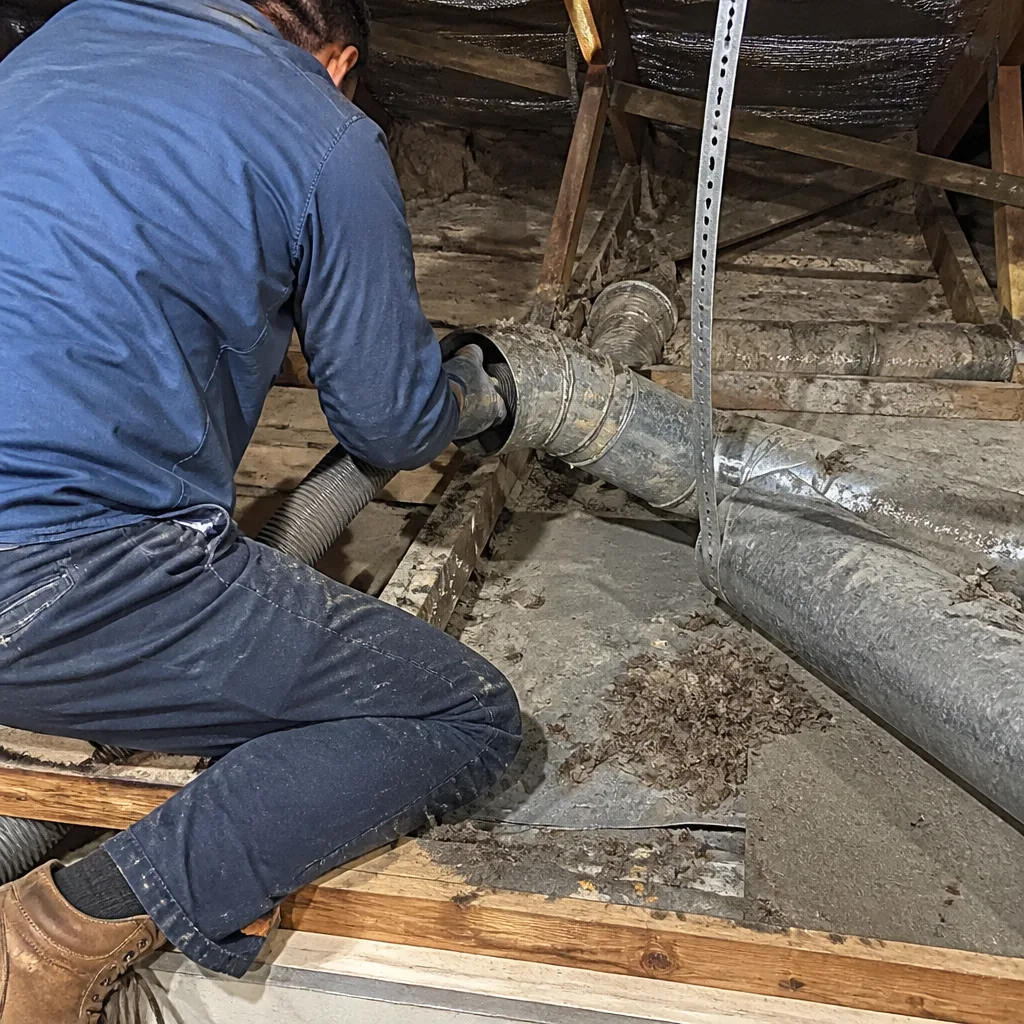 Before
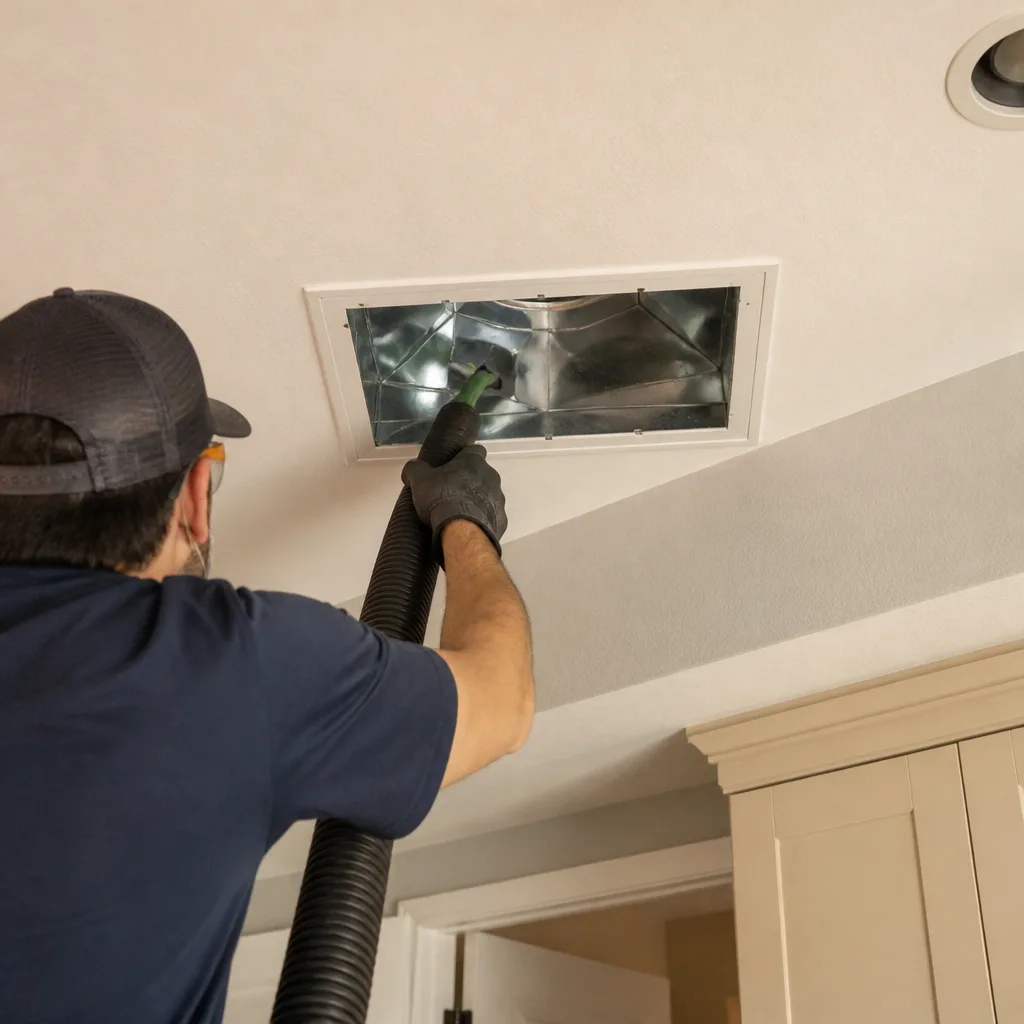 After
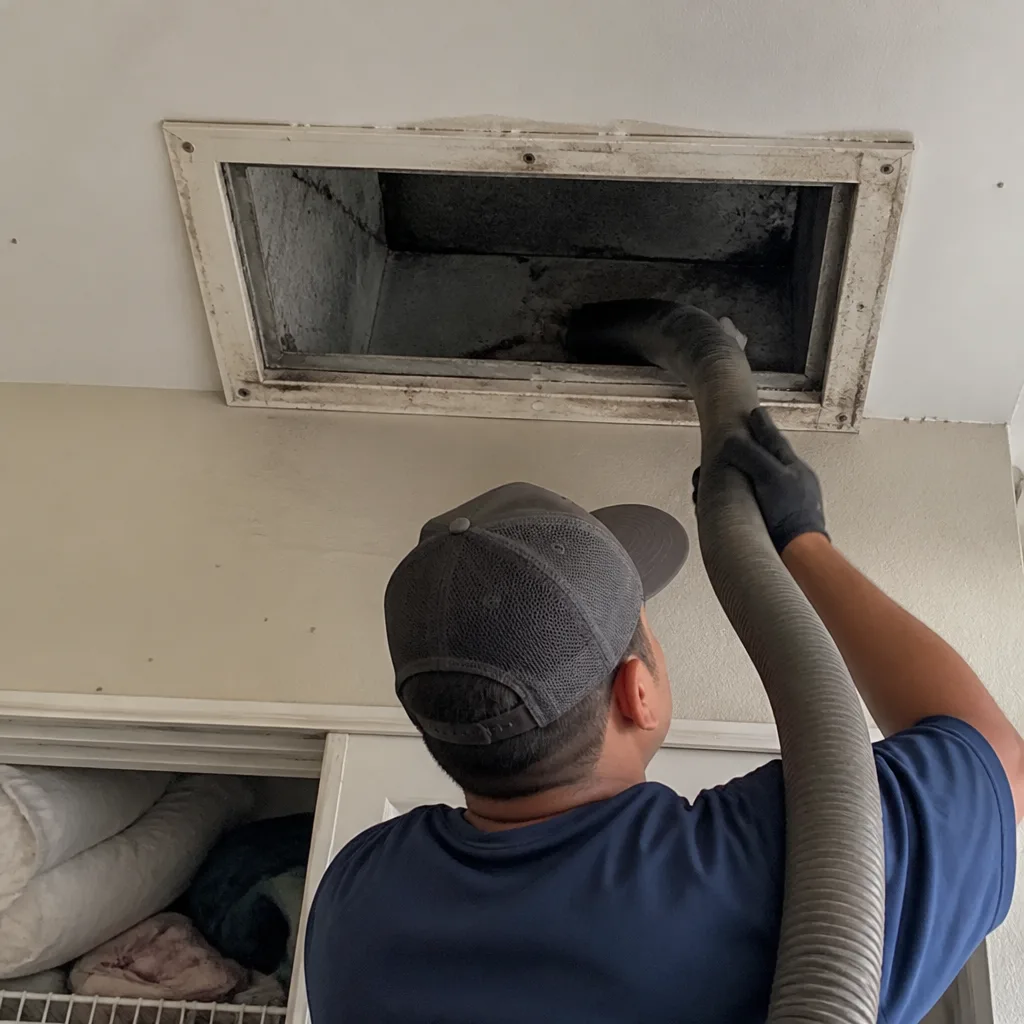 Before
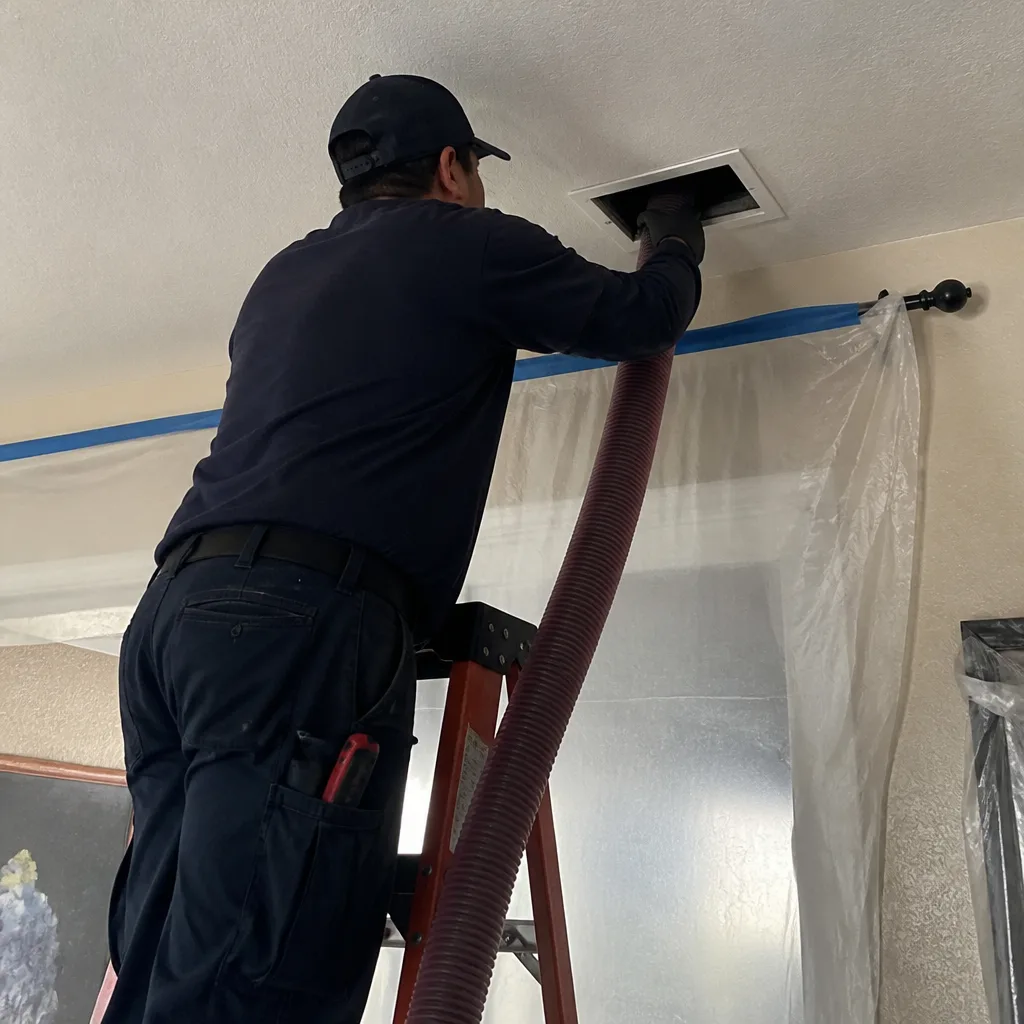 After
When to Call a Professional
Call for professional evaluation when a register inspection shows dust accumulation inside the duct run beyond the boot, when flex duct is sagging or disconnected, when smoke odor persists after outdoor air clears, or when allergy symptoms correlate with system operation. These are the signals that point to contaminant loading or airflow failure that household tools cannot correct. Duct Cleaning Hemet offers free estimates in Hemet, and our technicians arrive with equipment designed for the specific conditions your ducts face: rotary brush agitation, HEPA vacuum extraction, and the same Abatement Technologies filtration units used in professional remediation environments. If your inspection turns up something you’d rather not touch, call (877) 752-8890 and we’ll assess it honestly.
Frequently Asked Questions
In Hemet, you should check your air filter monthly and replace it when it’s visually loaded, which is typically every 30-45 days during Santa Ana wind season and every 60-90 days during calmer months. The 90-day rule that most filter packaging cites assumes average conditions that do not apply to the San Jacinto Valley’s dust load.
You need professional air duct cleaning when visible dust accumulation extends beyond the register boot into the duct run, when supply registers show dust returning quickly after cleaning, when smoke odor persists after filter replacement, or when you can see particulate being blown into rooms during system operation. These are signs of contaminant loading that a filter change cannot address.
A household vacuum and brush can clean the first few inches of the register boot, but cannot reach the duct interior, cannot generate the negative pressure needed to capture dislodged particulate, and often pushes debris deeper into the system. Professional cleaning uses rotary brush agitation paired with HEPA-rated vacuum extraction, which is fundamentally different equipment than anything consumer-grade.
Rooms that stay persistently dusty often have a duct leak or disconnection on that specific run, pulling attic air and dust into the supply path. Cleaning the room treats the symptom while the duct defect continues feeding dust. The fix is air duct repair on that run, not more housekeeping. Call (877) 752-8890 for an inspection if this pattern matches your home.
Not necessarily. A higher MERV filter captures more particulate, but it also restricts airflow, and in older Hemet homes with undersized return plenums, that restriction can reduce system performance and cause coil freezing. The right filter matches your duct system’s airflow capacity, and that’s often MERV 8-10 in older homes rather than the highest rating available.
If smoke odor persists in supply air after the outdoor air has cleared and you’ve replaced the filter, the smoke particulate has likely bonded to the duct interior and professional cleaning is justified. A light smoke event with no persistent odor and no visible gray film on register boots may only require filter replacement and continued monitoring. Each fire event deposits different particulate, so check your registers for any visible smoke residue before deciding.
The Bottom Line
A functional maintenance routine for Hemet ductwork is built around local conditions, not generic calendars. You’ll check filters more often than the packaging suggests, inspect registers monthly for patterns, keep an eye on flex duct connections in the attic, and document everything with photos. When your inspection finds something your household tools can’t fix, whether that’s deeper duct contamination, damaged flex runs, or persistent smoke odor, the next call is to professionals with the right equipment. Duct Cleaning Hemet provides dryer vent cleaning in Hemet alongside duct cleaning and repair, covering the full indoor air system rather than one isolated component. For maintenance questions, free estimates, or a second opinion on anything you’ve found in your attic, call (877) 752-8890.
Written by the team at Duct Cleaning Hemet, serving Hemet since 2013. Explore more guides & resources on indoor air quality.